This blog is created with the intention of passing the stories that I have heard from my parents or those I have experienced myself onto my two children. Since they were brought to New Zealand from Taiwan at the age of 10 and 5 respectively in 1992, English has become their main language. Therefore, I find it necessary to write the posts with my limited English.
Tuesday, January 27, 2009
On The Pure Land Path
But they know very little about what activities are held there; why it attracts me to travel all the way by bus to attend every week; what do I pursue on this path? I suppose they have some ideas about Buddhism - it talks about emptiness and various philosophical yet abstract topics; it was founded by a prince of ancient India; and it is mainly welcomed by old fellows. And that are all what they might know about.
So I like to write this post to tell my friends, especially my two children the basics of this tradition.
The following are what I learned. About 2500 or 3000 years ago, a prince of ancient India, by an enormous cause, got a chance to leave the palace and saw things that he could only see in the outside world. He saw a very old man staggering along the street; he saw a sick man lying on the roadside; he saw a corpse surrounded by the mourning family. He was overwhelmed by what he had never seen in the palace. And he saw a spiritual practitioner as well. This encounter triggered his realization of the truth of life, and resulted in his drop out of palace one night to start his quest for solution of complete liberation. (This link will bring you to a 40 minute video which gives detailed description about The Life of The Buddha.)
After 9 years of diligent practice and seek for the truth, he achieved enlightenment under the Bodhi Tree. He found the answer of life and discovered fact of the universe. He was free from the endless cycle of rebirth. He was completely liberated.
I imagine what the Buddha was thinking after his enlightenment. He was thinking that he should share with all beings how he had reached the state of full liberation, what the liberation was like; he should start his teaching. So he walked out of his retreat to begin his preaching that lasted 49 years long till he dropped his physical body and entered Nirvana, the ultimate state of being free from suffering and cycle of rebirth.
His teaching came to China in the middle of 1st century, and was naturally localized and diversified into many different schools to suit individual learners of various nature and capacity. Among them are schools such as Cha'n (or Zen in Japan), Tendai, Pure Land and etc. Despite that there are so many different schools, their main courses are all the same - following the three learning steps: Observance of Precept, Mindful in Concentration and Ultimate Wisdom.
I was brought onto Pure Land path through viewing Venerable Chin Kung's DVD titled "Getting To Know Buddhism". This school teaches us how to go through the above mentioned three steps by reciting "Amituofo". So in the group meditation practice, you can see they walk in round in the chanting hall aiming to tame our wandering mind to achieve mindfulness by focusing our thought on the recitation of Amituofo.
My personal experience from practice Pure Land path tells me mindfulness is the most difficult skill one can learn in his lifetime. Try it yourself. Sit on a chair comfortably, close your eyes, take a few deep breath, and then try to still your thought. How do you feel? Can you hold the stillness for a few seconds? It is challenging, isn't it? A renowned spiritual practitioner had lived in a cave in remote mountain for 12 years doing intensive meditation retreat. Once she was asked by people about how she felt during her retreat. She said to them that she was never bored during that period of time. Obviously she had tasted the heavenly happiness through her diligent practice.
Though it is difficult, it is a lot of fun and enjoyment in cultivating this skill because you will gradually gain the long lasting calmness and bliss if you persevere. And don't forget, our ultimate goal is to achieve Paramita Wisdom, the perfectly awaken state of mind, the state that free us from the endless cycle of rebirth.
Recently I heard from some of my friends that their parents were suffering from various diseases such as Alzheimer, Diabetes, Incontinence etc and had become bed bounded for quite some time. Although their life is long, all are over 90, but the diseases resulting from longevity make them suffer. That's why in the first sermon that Buddha delivered after his enlightenment pointed out that life is Dukkah, or is never satisfactory. To my perspective, Pure Land path is designed to train us to be in control of our worldly life, to get us prepared to migrate to the Pure Land at our will.
Knowing that no one can bring anything along after our life is ended, isn't it the most urgent and important task to be prepared to break the cycle of rebirth in our lifetime?
Tuesday, January 06, 2009
Chenny's Babysitter
In the picture is the couple who helped us babysitting Chenny after my wife’s maternity leave was over and had to go back to her teaching job. They are Mr. and Mrs. Guo. Mr. Guo’s full name is Guo Bin Wu 郭斌武, which carries a meaning as “being courtesy and heroic”.
Today I like to write some of his stories for a couple of reasons. Firstly, we owe him a lot in terms of the sacrifice he made in looking after Chenny. Secondly, he just passed away due to his long term stomach illness in November 2008, so this post serves as a commemoration to him.
Following the local custom, we called him Guo Yeye meaning Grandpa Guo, and his wife Guo Nainai meaning Grandma Guo because Chenny was supposed to adress them Guo Yeye and Guo Nainai.
By the time when Chenny was to be delivered, my parents being 72 years old were no longer physically fit enough to look after a baby for us during the daytime when we were away at work. We were referred to Guo Nainai, who lived near to where we lived in Taipei city. She politely declined our request at first because Guo Yeye was turning 65 and would soon be discharged from his job in an administrative position in the National Security Headquarter. They had planned to live a retirement life style. We were quite worried as the date of expected labour approaching.
After Chenny was given birth, we tried to ask for their assistance again. This time Guo Nainai nodded. We later knew from other neighbours that because Guo Yeye committed to spare his time to give Guo Nainai a hand in caring the baby. We were relieved and grateful. We knew this was due to the profound loving-kindness of this elder couple.
Prior to giving Chenny to Guo Nainai’s care, Chenny had lived with us for 6 weeks till my wife’s maternity leave expired. During this period we had already learned Chenny was a tough baby to look after. He cried a lot. He was very active when not in sleep. He was awakening easily by small noise. He ate a lot but would suddenly not want to eat any for no reason for a couple of days which made the carer worry. So, by the time when we handed Chenny’s care over to them, we felt sorry and guilty for Guo Yeye and Guo Nainai. Fortunately Chenny was a good looking baby that they loved him instantly when they held him.
At the end of their first day care, I went to fetch Chenny with nervousness worrying that Chenny might have given them a hard time. I knocked on the door; Guo Nainai came to open the door for me. Guo Yeye was holding Chenny in sleep. I asked in low voice “is everything alright?” Guo Yeye smiled shyly and replied “not too bad.” Followed by a faint sigh almost undetectable but somehow I caught it. In my mind I said to myself “gee, Chenny did give them a hard time on the very first day.”
For polite reason Guo Yeye always replied “not too bad today” when I asked how Chenny behaved that day. Other neighbours who dropped in to see them actually witnessed how difficult Chenny was in Guo’s care, and how patiently Guo Yeye/Nainai were with Chenny. They told me that whenever they dropped in, they saw Guo Yeye either holding the finally falling into sleep baby in his arms or was swaying a crying baby trying to calm him down. They predicted that soon Chenny would be rejected from Guo’s care when their energy and patience ran out.
Day after day, month after month, we had lived with uncertainty of seeing Chenny rejected from Guo Yeye/Nainai’s care. But no, Chenny was not returned by his carer, instead Guo Yeye/Nainai announced in the community that they adopted Chenny as their grandson. They verified one day that they indeed felt enough in the first couple of months and thought of giving up, but while time went on, they found an emotional tie between them and Chenny was building up.
As time went by, Chenny was not crying as much as when he was a new born baby, but his excessive activity still made Guo Yeye/Nainai exhausted each day. This was carried on till Chenny reached one year old when my wife decided to take Chenny to live with her in Danshui, a small town on the outskirt of Taipei, where she worked as a school teacher. This decision was based on the consideration of the fact that we needed a 24 hour care for Chenny during the work days yet Guo Yeye/Nainai couldn’t do it physically. This decision was cruel to all of us especially Guo Yeye/Nainai.
Chenny’s second babysitter was Du Ayi, aunty Du, an ex-hospital-nurse. Du Ayi was at her early 30’s when Chenny was under her care, much younger and fit to be able to look after Chenny. And Chenny was with her for the following two years till my wife enrolled him in the junior kindergarten in a kindergarten ran by Presbyterian Church in Danshui.
In September 1992, we were to leave Taiwan permanently for immigration to New Zealand when Chenny was nearly 5 years old. Again this decision hit Guo Yeye/Nainai hurtfully. They came to Danshui to say goodbye to Chenny and presented him a gold necklace as shown in the picture, and two albums of stamp collection.
Life is impermanent, one day in November 2008 we were informed of Guo Yeye’s death and his funeral being on the 16th of December. We were not able to attend his funeral and Tessie, our daughter, happened to be travelling to Taiwan for holiday in December so we made Tessie our representative to pay respect to Guo Yeye.
Tessie sent back updates regularly during her stay in Taiwan. She told me that according to Guo Nainai, they included Chenny in their family list on the obituary notice. This conveyed a significant meaning that they seriously treat Chenny their own grandson. And what made us most uneasy was the e-mail that Tessie sent back after her attendance in Guo Yeye’s funeral. She said in the e-mail it was Guo Yeye’s will to give some money to Chenny as ‘hand-tail money’, a local custom, symbolising handing-down of responsibility of the dead to his descendant, and Guo Nainai had asked her to pass the money to Chenny when she returned to New Zealand.
This post is to commemorate a loving-kind elderlies whose love to his adopted grandson is so altruistic, and to serve as a forever reminder to Chenny about this spiritual tie between him and Guo Yeye.
Sunday, December 07, 2008
Happiness

One of my previous posts, Guide to Happiness – Di Zi Gui, draws the most visits among all of my posts. This reflects a fact that people all over the world are keen to secure happiness, or are not so happy that they seek for ideas on the web.
I write post on happiness. This does not necessarily mean I am happy or I am a doctor of happiness. Instead, I am like the most of those happiness seekers, I do sometimes Google “happiness” for ideas of pursuing real happiness. With lots of reflection on this issue, I have gained some knowledge about it.
First I conclude the cause of being unhappy is that we do things in a self-centred mind.
Unfolding from the self-centred mind setting we will subsequently and naturally trap in thoughts that arise to defend for this Self. These thoughts urge the Self to go ahead fighting for the desired result even if harming others is necessary. This process ends up in an exhausted body and mind no matter the desired result is achieved or not.
Example: An office guy is overly self-centred. He is ambitious to be promoted. We can predict how is he going to behave, what is he going to do, what will he be thinking. He is likely to do anything to impress his boss. He tends to tell tale of his prospective competitors. He will deliberately show off his skills whenever he can. The end result of his ambition could be like this. He wins in the competition and gets his promotion. He is happy for some time, then he finds so many of his colleagues dislike him. He has achieved something but is unhappy about some other things.
All the day-to-day things we experience are in this pattern – we achieve something and be happy a bit but at the same time we find some other things annoying arise. If we allow this self-centred mind setting to remain or even to grow bigger, we suffer; we experience the sense of being unhappy.
Now that we agree the cause of being unhappy is from being self-centred, is it easy to get rid of that kind of mind setting? The answer is positive. The evidence is the historical Buddha, the prince of ancient India, Siddhattha Gotama, and numerous spiritual sages and teachers.
But folks, it is never an easy task to completely reverse the self-centred mind setting to become the other-centred one. To say is always easier than to be done. It took the Buddha eons of time to achieve the goal. He is on the extreme end of the happy scale, let’s say, the ultimate 100% achievement. The rest of the real happy sages and spiritual teachers fall on the scale from 70% to 99%, I estimate. Thus if we are able to achieve a 10% other-centred and a 90% self-centred mind setting, we should begin to feel a sense of genuine happiness arising.
What is the formula of the self-centred to other-centred transforming process?
As I am a Buddhist, so I believe the formula is in Buddha’s teachings recorded in all the sutras. They say the Buddha has taught 84 thousand methods of the transforming technique to suit each unique individual happiness seeker.
I would like to conclude this post by a verse taught by Master Yin Guang, thirteenth Patriarch of Pure Land Buddhism. He says if one can endeavour to comply with the life attitude set out below one is not far from Buddhahood, the ultimate blissful state.
• 敦倫盡份 閒邪存誠 諸惡莫做 眾善奉行。Play your role well and fulfil your responsibility; Disable the evil thoughts and remain the purity; Refrain from all bad deeds; Put hands on all good deeds.
Monday, October 27, 2008
Celebration of Chenny’s 21st birthday

The 8th of October 2008 is the 21st birthday of my son, Chenny. Although 21st birthday is a big celebration to all young people, but did not seem to be so to him, because he was busy in preparing the term exam. His girlfriend secretly organized a birthday party in a restaurant, called him up that night, asked him to be present, and pushed him into the hall blindfolded to make him a surprise. When Chenny told me what happened in the party, I thought after all girls were more thoughtful.
A few days prior to his birthday, we knew this one got to be a bigger one, and was thinking what to offer. My wife decided to do something our parents did for us when we were small for him on that day. After all, she is supposed to be more thoughtful than me so I just let her plan go through.Early that morning, she boiled two eggs, dyed them into red, wrote “Happy 21st birthday“on both, and placed them on the table. When he came to the dining table and saw these lovely red things, he smiled a while but looked a bit confused as if asking “Is this for my 21st birthday?”
What my wife planned to do was to give a speech about the real meaning of celebrating a birthday when Chenny saw the red eggs. Anyway Chenny’s 21st birthday celebration from his parents is very culturally special and unforgettable to him.
The speech my wife delivered that morning was like this:
Son, it is ok to hold a joyful party in a format of food, drink, friends, and fun for your birthday today. But I want to use of this opportunity to tell you how children of our generation celebrate their birthdays, and what we all should bear in mind on our birthdays.
When we were young, the economy in Taiwan was not good. Birthday cake with candles was never heard of let along a birthday party. Yet, as parents, they wanted to do something special on their children’s birthday. Early in the morning, my mother already boiled two eggs and dyed them in red after they were cooled down a bit. As soon as I was leaving for school, she gave me a pat on my head, told me it was my birthday, prayed in murmur that I should grow into a healthy decent person, and put the still-warm eggs into my pocket. Then waved me good bye by the door step. The warmth and the red colour of the eggs in the pocket gave me a special feeling of birthday whole day long.
It is now the 21st century. People already forgot those days when material was not abundant as today. Birthday party in general becomes an occasion of eating, drinking and having fun. Very few will ever visualize the scene in the maternity ward of hospital where mother is bearing the agonizing pain till her baby is given birth.
As this is your 21st birthday, a day that means so much to you, so we decided to celebrate it uniquely for you by reversing the style that is followed by today’s society. Mum and dad’s blessing is more meaningful than a big party dinner. Also important is that a birthday should be the day to thank mother’s love. We wish you keep growing into a healthy and noble person.
After the speech, Chenny smiled sheepishly and gave us a hug and left for school with those two red eggs in his bag. This 21st birthday of Chenny’s is indeed a very unique one.
Sunday, July 27, 2008
Helping as a nanny
Tuesday, June 03, 2008
In memory of my mother
June 28 is the memorial day of my mother. On this date in 2002, she left this world. Every year when June arrives, bits and pieces of memory about mother and me arise. This year I like to commemorate her by writing some of her stories prior to her memorial day.
Mother was the second daughter of my maternal grandparents who rented my paternal grandfather’s land to plant crops to feed their family. At the age of 10, she obeyed her parents’ command, walked into Chen family as a fostered child daughter-in-law. That was a smart idea my paternal grandfather proposed. He knew my mother’s natural father was a modest and honest farmer, he believed descendants of good people would be nice for his son, my father. So he said to my grandma that he wanted to get that girl, my mother, into Chen family to be trained well before she was officially married to his son.
Buying fostered child daughter-in-law was a common practice found among rich families of my grandparent’s era. So my mother, at the age of 10, carried a simple pack of belongings, holding the sad emotion of leaving her own family, though poor, with her mother’s company, walked from her village for 3 miles to Chen family in the town. She told me late in her life that from time to time she resented her mother being so cruel selling her for the survival of the family.
Before she was officially put together with my father at age 18, she was trained to be a good wife. As a 10 year old child, her first mission was to look after my great grandmother. She shared a bed with my great grandmother. She walked alongside of her grandmother wherever she went. Before long, her responsibility extended to include cooking for this big family of about 20 people including grandfather’s team of carpenters. She was meant to get up before four o’clock in the morning to start cooking breakfast and boiling hot water while everyone was still sleeping. She recalled the hardship of that cooking task, in the winter time to a child using the very conventional olden day kitchen facilities. She had to be standing on a short stool so as to be high enough to work on the stove. It was even harder for her to get up in the morning when there was a cold blitz. She cherished her grandmother’s kindness. She said that often her grandmother woke up seeing her struggling to get up, pulled her back to the warm bed, asked her to sleep for a little longer and she would remain awake in order to wake her up for her cooking tasks.
Part of my grandfather’s training plan for his fostered daughter-in-law was sending her to school which was my mother’s dream. So she was taken into grade four skipping the first three years for a normal child because of her height and maturity. Though she was excited about being given the opportunity to go to school, this unusual class placement was a great challenge to her. She got to work harder to catch up. My grandfather spared some of his working time everyday to teach her learn new words. Soon my mother caught up with the other students despite her big load of household tasks, and became the top few students of the class. Composition was her strength. One of her writings was put on the bulletin board to be shown to the whole school.
Mother graduated from school with excellent marks. She begged for further schooling. Her teacher came to visit my grandparents hoping to make them agree with her request to go to high school. My grandfather agreed, however, grandmother thought a daughter-in-law with high school certificate would be arrogant and uneasy to be disciplined, so she rejected her request. My mother was very obedient, she just accepted the reality.
As originally planned, she was married to my father at the age of 18. Their first child was a boy. Unfortunately this boy, my eldest brother, died at very young age in a catastrophic earthquake occurred in middle part of Taiwan. This tragedy hurt her deeply. But fate didn’t just stop fighting against her. Before me, there were two of her children, a boy and a girl, died during their babyhood. They were said to be very cute and healthy. The whole family pampered them very much. But a sudden attack of fever lasting a few days and they were gone. My mother later recalled this heart breaking experiences, still felt the hurt vividly in her mind.
Before I was born, there was no son to carry on Chen’s name. My mother was very worried about the gender of the baby in her pregnancy in 1950. Her anxiety about whether the coming baby would be a son or a daughter was especially high because my grandma was very frail then and kept telling my mother that her soul would never be consoled if this time was not a boy. Mother relieved upon giving birth to me, a boy, and the midwife held me to show to my grandmother in her bed. Three days after my birth grandma died with her wish for a grandson fulfilled.
With 6 children to feed, mum and dad got to work very hard. Dad worked as a technician for a timber mill in a neighbouring town, and mum got to pick up the load of running a grocery shop and getting the household chores done at the same time. I often saw mother panting and sweating all day rushing around with the things to do. Once I remembered in a summer evening when I was about 6 of age, there were the three daughters of our neighbour gathered at our kitchen, and I heard they were saying, “we come to watch Obasang (auntie, in Japanese) having her dinner.” In my mind, I wondered what was my mum’s eating her meal of any special? Then I saw my mother rushed back home from our shop, sweating. She greeted these three girls knowing they came to watch her performing of eating a meal. Silently she picked up a bowl, filled it with rice porridge, picked up chopsticks, shovelled a big mouthful of the thickened porridge then picked up bit of side dish and put it into her mouth to chew, and then gulped them down. With 3 repeats of the same movements, the bowl was emptied. Within about 3 minutes, mum had done her meal with her back soaked by sweat. The process was watched amazingly by these audiences. One of the girls commented, “It is an enjoyment watching Obasang eating her meal. The meal seems to be delicious from the way Obasang eats.” And of course, mum smiled at them silently after the meal and rushed out to look after our shop.
Since mother started learning how to cook from 10 years old, she was good at cooking. She could make a good meal in less than one hour including preparation, cooking and tidy-up. The dishes she made were of the class of a restaurant. But of course, we could only get the chance to enjoy mum’s delicious dishes on special occasions such as New Year’s Eve and traditional festivals. Although mum was capable of making delicious food, she actually dreaded any big day on which she was supposed to do fancy cooking apart from looking after her shop. On any of that kind of big days, she got to get up even earlier to organise everything for the shop first. Then, she left the shop to my 3rd sister to look after while she rushed to the market to shop all the cooking material. Then, she needed to wash, peel, cut, chop, marinate, pre-process all by her alone to get all the material ready for making various kind of yummy dishes. At the end of the cooking and worshiping ritual, she always exhausted and could only lay on the bed for a short while before going to our shop to close it for the day.
Her life was a bit relieved after my father decided to get our shop sold, and shifted to live in Taipei from Ching Shui. My father was employed as office assistant in my big brother-in-law’s company. This job did not earn him enough income to support us, so my mother offered to serve as the company’s cook taking care of the 3 meals a day for the office employees. This supplemented the family’s income.
Mother’s life was noticeably improved after I had graduated and fulfilled my 2 year term of military service and got a job. This period began in 1975 when Taiwan economy grew rapidly. Mum had opportunities joining in tours to quite a few touring destinations in Taiwan. But she did not want to just let me carry the burden alone; she sought for casual job available in our community. There was an umbrella manufacturing factory in our community. They needed more hands to sew the fabric onto the umbrella skeleton. That was not a laborious job, but was rather tedious and required great patience to do it. She persuaded my father to take part in this simple but tedious job. So they started sewing umbrellas.
They started early in the morning no matter it was summer or winter. Sometimes it was so cold in winter morning, and yet she already started sewing the umbrella before dawn. A few times I asked her why not sleep-in a bit. She said to me, “You will know an elderly cannot sleep long when you are at my age.” Sometimes, I stood at her back and gave her a massage over the neck and shoulders, and I could feel this small offering brought her great happiness.
In January 1989, father died at age 74. To my mother, father’s death must have triggered her box of memories as he was the one she had known of since age 10. They had woven their memories over 63 years of time together despite the fact that there was more bitterness than joy.
In April 1990, I accompanied mum to visit 4th sister in Canberra who immigrated to Australia in 1989. That was mum’s first time ever travelled overseas. Upon seeing each other at sister’s front yard, this pair of mother and daughter hugged each other tightly bawling loudly. The emotion erupted like a collapsing dam. To mum, she was just recovering from the loss of her closest man, and to my sister, she was adjusting to a totally new life in a new country. Both of them had tried so hard to compress their emotion to prevent it from eruption, and now it had got its breaking point.
Mother had great impression on the living quality of western country on this trip to Australia. And this could be related to our decision of immigrating to New Zealand in 1992.
Socialable as mother was, she soon had very good interaction with many of the new Taiwanese immigrant families. She attended the local primary school activity, too. Once my son’s school invited all the grannies of their school students to take part in their teaching activity. Each of the invited grannies was to tell the students in their group about what kind of games they played at school when they were young. My mother had no English, however, she bravely entered the classroom together with many English speaking grannies. Sitting on the low stools in a circle with the students of their group, they began their activity. I saw mum from outside the classroom smiling all the time; sometimes looked at the children, sometimes looked out the window seeking me. She told me later that she felt a bit nervous but could feel the friendliness from other grannies and the children.
To an elderly like mum, living in a culturally new country is a torture, and I could only appreciate it myself a few years after our arrival. There were a lot of mental sufferings such as loneliness, frustration, isolation, nervousness and etc. But all are too late. There was no go-back; my children had been accustomed to local life style. I felt sorry for mum. And it could be due to these sufferings, mum devoted her time in practice Buddhist cultivation when we were out at work and her grand children were in school.
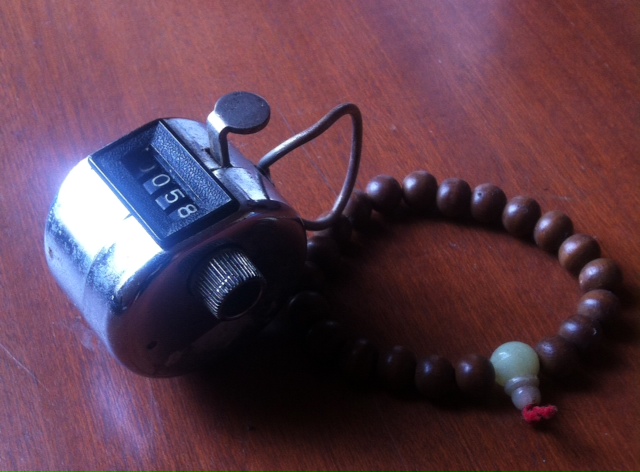
She had a counter brought from Taiwan. When she chanted Amitofo (Buddha name) for a whole round of her chanting beads she recorded 1 into the counter. Thus she went on chanting, chanting, chanting till the time we all came back from work and school. Then she called us into her room one by one. She then stood beside us, holding her chanting bead ring and lightly stoking over our back, murmuring her pray and transferring her merit gained from the chanting to us. I later realised that the so called Buddhist retreat in a monastery is similar to what mum had been doing during that period of time. They practice isolation, silence, mindfulness, all as what mum did.
In July 2001 when mother was 86, her weakening kidney made her frail and her doctor sent her to stay in North Shore Hospital for one week for a thorough test. Coincidentally my work was very busy with a lot of incoming stock, so I could not take a whole week leave for mum’s companionship during her hospital check-up. I had to be in and out of her ward and my work when nessary. She could manage to be in hospital by herself in the day time, but was scared of being there without having me beside her in the night time. So the night shift nurse was kind enough to get me a lying chair to sleep by her bed. Mum’s high social skill astonished me when one day I dropped in from work seeing her talking to the resident of her neighbouring bed, a local Kiwi, by means of body language.
The result of the check-up indicated that mum’s kidneys were beyond the effect of medication available, and doctor thought that her condition was not suitable to apply urine analysis treatment as well. Then she was discharged from the hospital with new prescription of antibiotic for keeping her chronic kidney inflammation under control.
Mother’s fragility was getting worse by month after her last hospital stay. Walking from her room to our dining room could take ages to complete, so I requested a wheel chair from the hospital to move her around in the house. This was about the last 3 months of her life time when she became bed bound. The last month saw her losing her appetite. I asked her if there was any pain or discomfort, and she said no pain except being weak. To a devoted Buddhist, having no pain and discomfort and being conscious at the last stage of life is a great blessing.
On the 28th June 2002, I was preparing to go to work. Though knowing mum was very weak and had had no appetite for food for 3 days, I thought this was another day of saying good bye to her and would be seeing her in bed when I got home from work. I waved her good bye before going to work and she pulled her left hand out of the duvet, smiled and said in her mouth “good bye.”
When I was at work that day, I had an impulse of writing a fax to Dr, Alex Chan, her doctor. In the message I told him that mother had been very frail in the past 2 weeks and it seemed that her life was to come to the end any time. And I begged if he could make a home visit of her on that day? But I did not receive his reply before I was off the day.
When I got home and entered mum’s room, we exchanged greetings and then I proceeded with the routine of catheterisation to empty her bladder. Half way in the process, I suddenly heard mum breathed heavily and then all became silent. I raised my head and realised that mum had just passed away. In panic I rang her doctor at the clinic. There was no answer. So I rang his home. A lady answered my call in English, seemingly the doctor’s house keeper. I requested to speak to Dr. Chan; she declined. So before she hung up, I hurriedly said to her that because my mother was dying I needed to talk to her doctor. Still, she wouldn’t pass the phone on, instead she said to me that if mother was dying then I should call 111 for ambulance but not doctor.
I went back to mum’s room making sure the Amitofo music was still on. Beside this, my brain seemed to be blank; didn’t know what to do next. About 10 minutes after the phone, I heard a car driving up the driveway and parked by the door. It was Dr. Chan. He must have figured out, from the phone and the fax message sent to his clinic, that my mother was dying. He had no obligation with my request for home visit whatsoever, but he came. I was very grateful to what he did to my mother. After some checks, he proved her death. Upon hearing this announcement, tears came out of my eyes, and I knelt down before mum. Doctor held me up and asked me to get mum’s death certificate from his clinic next day, then I saw him off.
We followed the tradition of Pure Land sect of Buddhism to keep mum’s body undisturbed for at least 8 hours. During this period we played the Amitofo music non-stop to remind her soul of focusing on the goal of shifting to the Blissful World of Amitofo.
The funeral agent was called in the next morning to sort out the detailed arrangement of the funeral.
Our friend David Huang helped to invite whoever knew my mother to attend the funeral. My boss, Thomas Chiu, was invited by me to deliver a speech about my mother. Two of my colleagues, Mark and Dennis came to pay their condolences, too. Many of mum’s friends turned up. Mrs. Jean Huang presented a pair of flower bunches to pay her respect and condolences. My 4th sister and her daughter Meiling flew from Sydney to attend the funeral. I asked the funeral hall host to play the Amitofo music as the background sound throughout the event. The funeral was simple but very solemn.
As mum had mentioned to 4th sister once in their meeting that she wished to be cremated and her remain be kept in Fo Guang Shan Temple in Sydney. She had this wish because my 4th sister's huband, died two years earlier from liver cancer, was buried in Sydney and his soul plaque was kept in that temple, too. So sister arranged a Buddhist ceremony in the temple on August 3, and I flew from Auckland on the same day with the box of mum’s remain. We went to the temple directly from airport.
The solemn Buddhist ceremony began as soon as mum’s remain was placed on the altar by Buddha’s statues. The chanting of sutra, smell of incense, and the atmosphere in the hall triggered my sadness that my tears streamed down even after the rituals were finished. And then mum’s remain is stored in the pagoda where solemn Buddhist music and worships are presented twice daily to remind the souls of continuing practice in order to achieve complete liberation.
Almost 6 years after mother left this world, I write about her life briefly hoping my descendants whoever reads her stories will be touched by my mother’s decent spirit and endeavour to learn her virtues.
Thursday, April 24, 2008
Reflexology

I learned this technique from an elderly, Lee Ching Zheng, in Taiwan. Mr. Lee was an enthusiast of reflexology. He learned it from self-taught by carefully studying books published by a catholic priest, Fr. Joseph Wu, in 1980’s. He claimed that his mother-in-law had had spinal stenosis for a long time and required injection from the pharmacy almost daily. But since he started applying reflexology on her, she stopped going to the pharmacy for injection.
In 1985, Mr. Lee was keen to teach me this technique when he knew that my wife had been infertile since our marriage 8 years ago. Besides the free one-on-one lesson, he presented free tool, the massager made of wood for applying strength on the reflection spots on the foot sole.Through consistent practice of this technique for sometime, I became quite experienced, and I extended my service to cover all of my family members. Sore tooth, headache from cold, stomach ache, sore knee and etc were treated and the feedback were encouraging. Two years later, my wife was pregnant. Although we had tried other alternative remedies such as herb, acupuncture and Fensui at the same period of time, we believed reflexology had played a big part in my wife’s pregnancy.
Then in 1992, we emmigrated to New Zealand. One day in April 1992, I came across a piece of advertisement about tuition for reflexology on the newspaper. I thought reflexology is a thing only believed in the Oriental, but why it appeared in the newspaper of a western country. I was also surprised to know from the advertisement that the tutor was called Suzanne, a German nurse. Being curious to see if it is the same technique I had learned from Mr. Lee, I enrolled on this 3 day course to be held in Mt Eden Intermediate School.
On the day the course started, I entered the classroom and found that I was one of the only two Asians in the class, the rest of the class of 15 were Europeans. Then I realized natural healing technique is also believed by westners.
In the three day class, we were asked to practice hands-on to each other. When Suzanne asked us to find our own partner, I found that I seemed to be the most popular in the class because many of them came to ask me to be their partner. Once I was working with Shirley who was president of a speech club in Ponsonby. Her enthusiasm in learning this technique impressed me very much. The stuff we learned from the course was the same as I had learned from Mr. Lee in Taiwan.Life of an immigrant is busy and stressful. And it is especially so if you are from non-English speaking country. During this time, I had made acquaint with a Korean whom I called Ajoxi. He lived in the same suburb where I lived, so from time to time he walked to my place after dinner, and we usually had chat in the garden. From our talk, I could tell he was worrying something. Finally he told me he worried about his health because he constantly felt soreness somewhere in his abdomen. He did even grab my hand to touch that spot. I encouraged him to consult with his family doctor but he seemed to be reluctant to do so. Then I told him that I had learned a technique called reflexology. I also told him how it worked and if it did not work on him it at least harmed him nothing. So we did a few sessions. And one day I received his call, “hi, Dr. Chen, the problem in my abdomen is gone. From now on I should call you doctor Chen.”
Dr. Chen!? I felt being flattered yet there was a feeling of joy inside me upon hearing Ajoxi’s remark in the phone. A feeling of being helpful that was all because of my reflexology teachers – Mr. Lee and Suzanne.


